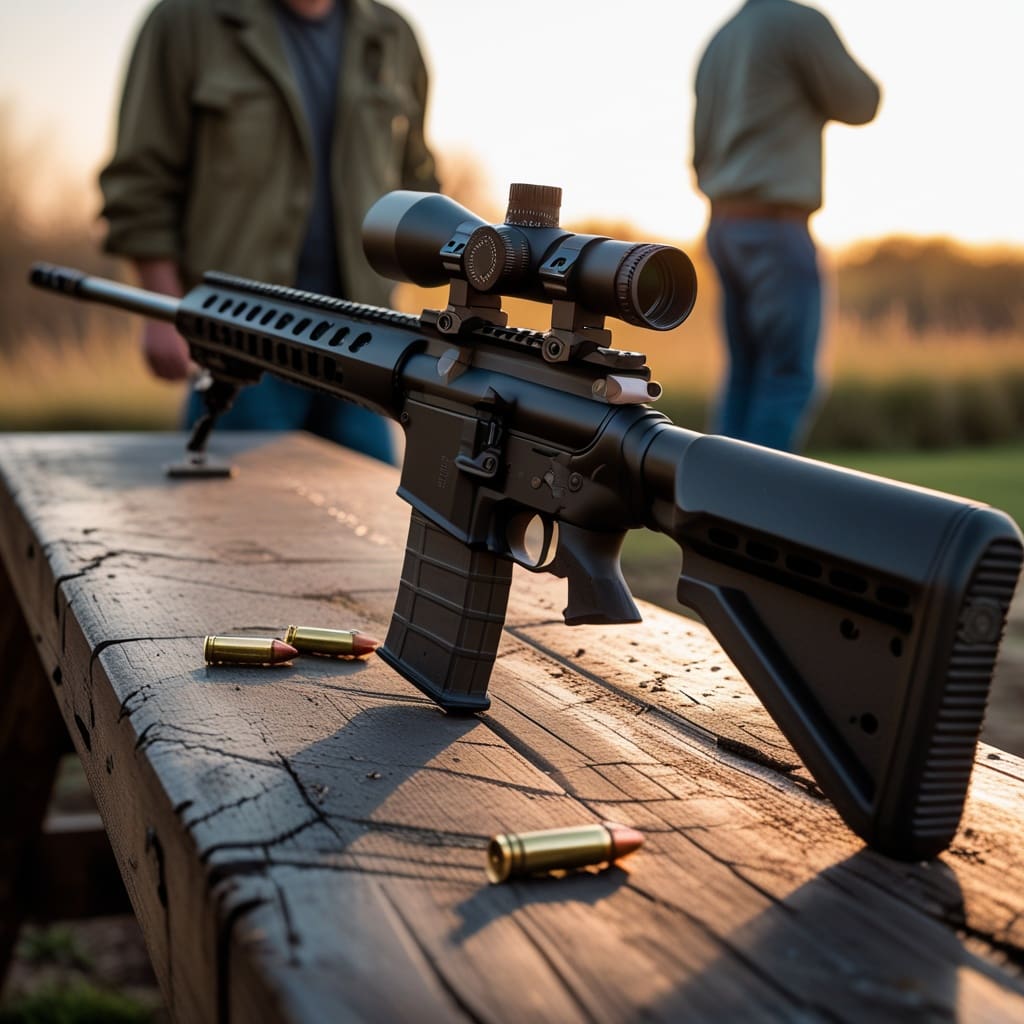
An LPVO scope, short for low power variable optic, is a rifle scope with a magnification range that typically starts at 1x and extends to somewhere between 4x and 10x. It gives you the fast, both-eyes-open shooting of a red dot at close range, combined with enough magnification to make precise hits at 200, 300, or even 500 yards. That combination has made LPVOs the dominant optic choice for three-gun competitors, patrol rifle carriers, and hunters who need one setup that works across multiple distances.
Demand for these optics has grown sharply over the past decade as manufacturers have driven weight down and glass quality up, while prices have spread across a wide range from roughly $150 to more than $2,000. Choosing the right one, and deciding whether you need one at all, depends on how you actually use your rifle rather than on marketing claims about magnification numbers.
Key Takeaways
- An LPVO scope generally offers 1x to somewhere between 4x and 10x magnification, letting you shoot fast up close and accurately at distance with one optic.
- Common LPVO configurations include 1-4x, 1-6x, 1-8x, and 1-10x, with 1-6x and 1-8x being the most popular for AR-15 platforms.
- Entry-level LPVOs start around $150 to $300, mid-tier models run $400 to $900, and premium optics from established manufacturers reach $1,200 to $2,500.
- Compared with a red dot, an LPVO adds weight (typically 16 to 24 ounces) and cost but extends your effective engagement range well beyond 100 yards.
- Whether you need one depends on your typical shooting distance, your rifle’s role, and whether you already own a red dot that covers your needs.
What Is an LPVO Scope?
An LPVO scope is a variable-power riflescope designed to function at true 1x magnification (no zoom, matching the naked eye) while also offering a higher magnification setting for precision shots. This dual capability sets it apart from a fixed-power scope, which locks you into a single magnification, and from a traditional red dot, which offers no magnification at all beyond a magnifier attachment.
Most LPVOs use an illuminated reticle, often with 10 to 11 brightness settings, so the aiming point stays visible in bright daylight or in low light without washing out. Eye relief on quality LPVOs runs between 3.5 and 4 inches, which matters for AR-15 platforms where the scope sits closer to your eye than on a traditional bolt-action setup. Tube diameter is typically 30mm on mid-range models and 34mm on premium models, with the larger tube allowing more internal adjustment range for windage and elevation.
The defining feature of any LPVO is genuine 1x magnification at the low end. A scope that starts at 1.5x or 2x is not a true LPVO and will feel slow and tunnel-visioned in close-quarters shooting.

How Does an LPVO Scope Work?
An LPVO scope works through an internal erector system that moves lens groups to change magnification, controlled by a throw lever or ring near the eyepiece, while a separate turret system adjusts windage and elevation in click values usually set at 0.1 milliradian (MRAD) or 0.25 minute of angle (MOA) per click. At 1x magnification, the reticle appears at roughly the same size regardless of scope design, which is why reticle placement matters so much for close-range speed.
Two reticle systems dominate the LPVO market: first focal plane (FFP) and second focal plane (SFP). In an FFP scope, the reticle grows or shrinks along with the magnification, so ranging marks stay accurate at every power setting. In an SFP scope, the reticle stays the same size no matter the zoom level, and ranging marks are only accurate at one specific magnification, usually the highest setting. FFP scopes typically cost $150 to $300 more than a comparable SFP model but are preferred by precision shooters, while SFP scopes remain popular for close-quarters and patrol use because the reticle stays crisp and thin at 1x.
What Magnification Range Should You Choose?
The right magnification range depends almost entirely on the distances you actually shoot. A 1-4x scope suits home defense and short-range competition out to about 100 yards. A 1-6x scope, the most common configuration sold today, handles everything from room-clearing distances to 300-yard shots with reasonable precision. A 1-8x or 1-10x scope pushes effective range past 400 yards but adds noticeable weight, often 22 to 26 ounces, and a higher price tag.
LPVO vs Red Dot: Which Should You Choose?
An LPVO gives you magnification for distance while a red dot gives you speed and simplicity at close range, and the better choice depends on how far you typically need to shoot. A red dot sight, such as an Aimpoint or a Holosun, weighs as little as 4 to 8 ounces, needs no eye relief consideration, and lets you engage targets almost instantly out to 50 or 75 yards. Beyond that distance, the dot itself begins to cover more of the target than most shooters want, making precise hits harder without a magnifier.
An LPVO closes that gap by letting you dial up magnification when the target is farther away, without switching optics or adding a bolt-on magnifier. The tradeoff is weight, cost, and a slightly slower first shot at close range compared with a dedicated red dot, since even at 1x an LPVO has more glass between your eye and the target.
- Choose a red dot if your rifle rarely engages targets past 100 yards, such as a home-defense carbine or a competition gun built for close stages.
- Choose an LPVO if you shoot across mixed distances, from 10 yards to 300 yards or more, on the same rifle.
- Consider both if you own multiple rifles set up for different roles, which is common among competitive shooters and patrol officers.
If you are still undecided, it helps to physically handle both optic types before buying. You can compare red dot options if you’re weighing them against an LPVO to get a feel for weight, battery life, and dot size before committing to a magnified setup.
What Is the Best LPVO for an AR-15?
The best LPVO for an AR-15 is generally a 1-6x model in the $400 to $900 range, since it balances weight, field of view, and price for the platform most owners actually shoot. Popular configurations from established manufacturers weigh between 17 and 21 ounces and offer eye relief of 3.5 to 4 inches, which suits the AR-15’s typical stock length of pull and rail mounting position.
Buyers looking at competition or duty use often step up to a 1-8x scope, which adds roughly 2 to 4 ounces of weight but extends confident hit probability past 400 yards. Budget-conscious shooters can find functional 1-4x models starting around $150 to $250, though glass clarity and turret repeatability tend to drop off noticeably below the $300 mark. For a rifle used mainly for home defense with occasional range trips to 200 yards, a 1-6x scope with an illuminated dot-style reticle at the center remains the most versatile single choice.
Which Reticle Type Works Best for AR-15 Use?
A simple illuminated dot or horseshoe reticle at 1x, paired with holdover marks visible only at higher magnification, works best for most AR-15 owners. This design keeps the sight picture clean for fast target acquisition while still offering ranging references when you dial up magnification for a distant shot. Reticles crowded with bullet drop compensation lines at every power setting can clutter the sight picture at 1x, which slows down close-range target transitions.
How Much Does an LPVO Scope Cost?
LPVO scope prices span roughly $150 to $2,500, with the difference driven by glass quality, turret precision, illumination reliability, and brand reputation. Below is a general breakdown of what you can expect at each price tier.
- $150 to $300 (entry-level): Basic 1-4x or 1-6x scopes with acceptable glass for daytime use, less reliable illumination circuits, and turrets that may drift under heavy recoil.
- $400 to $900 (mid-tier): The sweet spot for most AR-15 owners, offering true 1x, crisp glass, repeatable turrets, and illumination brightness that holds up in direct sunlight.
- $1,000 to $1,500 (upper mid-tier): Scopes with better low-light glass transmission (often above 90 percent), tougher aluminum housings, and longer warranty coverage.
- $1,500 to $2,500 (premium): Scopes built for duty and competition use, with FFP reticles, daylight-bright illumination, and glass clarity that rivals dedicated precision scopes.
Beyond the scope itself, budget for mounting hardware, which typically adds $30 to $150 depending on ring height and material. If you are ready to move from research to purchase, you can shop LPVO and variable-power rifle scopes across these price tiers to compare specific models side by side.
How Do You Mount an LPVO Scope?
Mounting an LPVO scope correctly affects both accuracy and eye relief comfort, and the process generally takes 30 to 60 minutes with basic tools. Follow these steps for a proper installation.
- Select the correct ring height. Most 30mm LPVOs need medium or high rings, typically 1.5 to 1.93 inches in inner diameter clearance, to clear the AR-15’s handguard.
- Position the scope for eye relief. Slide the scope forward or backward in the rings until you get a full, unshadowed sight picture with your head in a natural shooting position, usually 3.5 to 4 inches from your eye.
- Level the reticle. Use a bubble level on the rifle’s rail and another on the scope’s turret cap to ensure the reticle sits perfectly vertical before tightening.
- Torque the ring screws evenly. Tighten in a crisscross pattern to the manufacturer’s spec, typically 15 to 18 inch-pounds, to avoid warping the tube.
- Zero the scope at 50 or 100 yards. Fire a 3-shot group, adjust windage and elevation turrets based on the point of impact, and confirm with a second group before moving to distance.
Getting ring height and clamp quality right matters as much as the scope itself, since a loose or misaligned mount will cause zero to shift under recoil. You can check scope rings sized for mounting a 1-6x optic to find hardware that matches your tube diameter and rail height.
Do You Actually Need an LPVO for Your Rifle?
You need an LPVO scope if your rifle is used for shooting at varying distances, typically anywhere from 10 to 400 yards, on a single platform. Hunters using an AR-platform rifle for deer or hogs across open fields, competitive shooters in three-gun or PRS-style matches, and patrol rifle carriers who may need to identify and engage a threat at unknown distance all benefit from the flexibility an LPVO provides.
You likely do not need one if your rifle stays inside 100 yards for its entire practical use, such as a dedicated home-defense carbine kept in a closet or a rifle used only for close-range steel matches. In those cases, a red dot sight offers a lighter, simpler, and often less expensive solution with no meaningful loss of capability. The most common mistake new buyers make is choosing magnification range based on what feels impressive rather than what matches their actual shooting distance. A 1-10x scope on a rifle that never leaves a 100-yard indoor range adds unnecessary weight and cost without a corresponding benefit.
Conclusion
An LPVO scope earns its popularity by solving a real problem: the need for one optic that performs at close range and at distance without swapping equipment. Whether a 1-4x, 1-6x, or 1-8x model fits your rifle depends on the distances you actually shoot, the weight you are willing to carry, and the budget you have set, which realistically ranges from $150 for a basic model to well over $1,500 for a premium build. Match the scope to your actual use case rather than to the highest magnification number on the shelf, and you will end up with an optic that earns its place on your rifle rather than one that sits unused after the novelty wears off.
Frequently Asked Questions
What does LPVO stand for on a scope?
LPVO stands for low power variable optic. It describes a category of riflescopes that start at true 1x magnification and zoom up to a higher power, typically between 4x and 10x, on the same optic.
Is a 1-6x LPVO good for an AR-15?
Yes, a 1-6x LPVO is one of the most practical choices for an AR-15. It covers close-range engagement at 1x and extends usable accuracy out to roughly 300 yards, making it suitable for home defense, range use, and most competition formats.
Can you use an LPVO for hunting?
Yes, LPVO scopes work well for hunting, especially in brush or timber where shots vary from close to moderate range. A 1-6x or 1-8x configuration handles most whitetail deer and hog hunting scenarios inside 300 yards without needing a dedicated hunting scope.
How much magnification do you actually need on an LPVO?
Most shooters need no more than 6x to 8x magnification for practical use. Higher magnifications like 10x add weight and reduce field of view without meaningfully improving accuracy for shots inside 400 yards, which covers the vast majority of civilian shooting scenarios.
Are LPVO scopes worth the extra weight compared to a red dot?
Yes, if you regularly shoot beyond 100 yards, the added 12 to 16 ounces of weight is worth the extended range capability. If your shooting stays inside 100 yards, a red dot delivers comparable close-range performance at a lower weight and often a lower price.


