Buckshot is the superior choice for home defense in almost every scenario because it delivers more reliable stopping power per shot than birdshot, which was designed for small game rather than defensive encounters. The difference comes down to pellet size, mass, and penetration depth. A single shell of 00 buckshot fires eight to nine pellets roughly the size of a .33-caliber bullet, while birdshot scatters dozens to hundreds of pellets too light to reliably stop a determined attacker. Understanding this distinction matters because the wrong choice can leave you undergunned during the seconds that count most.
Key Takeaways
- Buckshot, particularly 00 buck, is the standard recommendation from firearms trainers and law enforcement for home defense shotgun loads.
- Birdshot pellets are too light (typically under 0.1 grams each) to consistently penetrate deep enough to stop a threat, based on FBI ballistic gelatin standards.
- The FBI protocol calls for 12 to 18 inches of penetration in ballistic gelatin, a benchmark 00 buckshot meets and birdshot generally does not.
- Overpenetration through interior walls is a real concern with buckshot, though birdshot is not a guaranteed solution and still carries risk at close range.
- Most defensive shootings inside a home happen within 7 to 10 feet, a distance where buckshot patterns stay tight and birdshot has not yet spread wide enough to offer any real advantage.
- A box of 25 shells of 00 buckshot typically costs $15 to $28, compared to $8 to $14 for a box of birdshot, depending on brand and shot size.
What Actually Separates Buckshot From Birdshot
Buckshot and birdshot are both shotgun shell loads, but they were engineered for entirely different purposes. Buckshot pellets range from about .24 caliber (#4 buck) up to .36 caliber (000 buck), with 00 buckshot (.33 caliber) sitting as the most common defensive load. A standard 2.75-inch 12-gauge shell of 00 buckshot holds eight or nine pellets, each one weighing around 54 grains, roughly comparable to a small handgun bullet.
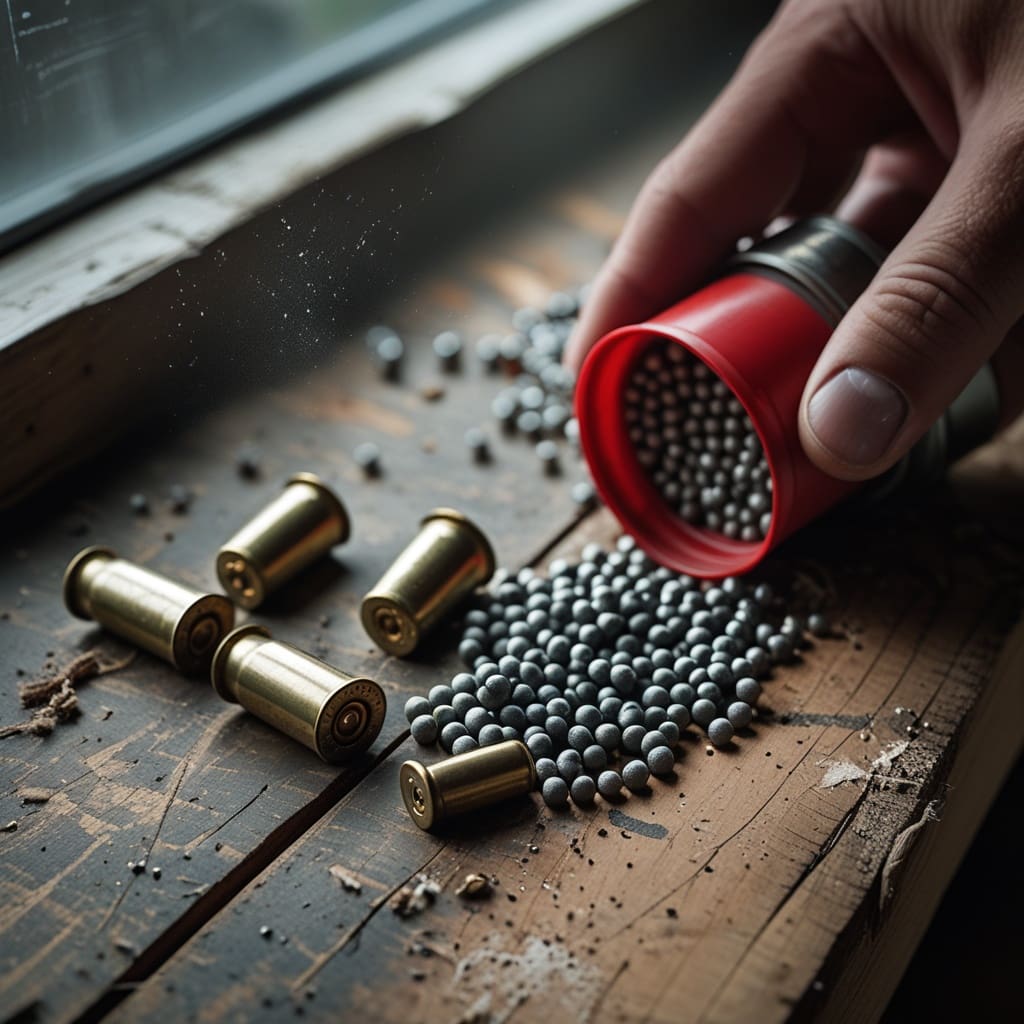
Birdshot, by contrast, uses much smaller pellets meant to bring down birds and small game without destroying the meat or requiring precise aim. Common birdshot sizes include #6, #7.5, and #8, with a single shell packing anywhere from 150 to over 400 tiny pellets. Each pellet might weigh less than 3 grains. That is a fraction of the mass carried by a single buckshot pellet, and mass is what drives penetration and energy transfer on impact.
The practical result is a tradeoff between spread and stopping power. Birdshot creates a wide pattern with many small strikes, which works well against birds in flight but poorly against a human target wearing clothing, standing behind furniture, or simply built with enough muscle and bone to absorb shallow wounds without going down.
Why Buckshot Is the Standard Recommendation for Home Defense
Firearms instructors and many law enforcement training programs point to the FBI’s ballistic testing protocol as the benchmark for defensive ammunition. That protocol requires a load to penetrate between 12 and 18 inches into calibrated ballistic gelatin, a depth considered necessary to reach vital organs through clothing, arms raised in defense, or other barriers a real attacker might present. Standard 00 buckshot from a 2.75-inch shell consistently meets or exceeds this threshold, often reaching 14 to 16 inches of penetration depending on barrel length and shell brand.
Birdshot, even at close range, typically falls short of the 12-inch minimum once it passes through a few layers of clothing. The pellets are simply too light to carry enough energy past the first few inches of tissue. This does not mean birdshot cannot injure someone. It absolutely can, especially at very close range where the pattern has not yet spread. But injury and incapacitation are different things, and in a defensive encounter, incapacitation is the goal.
Another factor favoring buckshot is pattern density at typical engagement distances. Most defensive shootings inside a residence occur at very short range, often between 3 and 10 feet according to data cited by multiple firearms training organizations. At those distances, a shotgun loaded with buckshot delivers all eight or nine pellets into a tight cluster roughly the size of a fist, concentrating energy exactly where you aim. Birdshot at the same distance also stays tight, meaning you lose the “wide spray” advantage people often assume it offers while still sacrificing the deeper penetration buckshot provides.
When Birdshot Might Still Make Sense
Birdshot is not entirely without merit in a home defense context, though the scenarios where it makes sense are narrower than many people assume. Some homeowners living in apartments, duplexes, or homes with thin interior walls choose birdshot specifically to reduce the risk of a shot traveling through drywall and into an adjacent room or unit. Birdshot does lose energy faster than buckshot after passing through a barrier, which can reduce, though not eliminate, the danger to bystanders on the other side of a wall.
Some trainers also point out that for a shooter who struggles with recoil management, a lighter birdshot load may allow faster, more controlled follow-up shots compared to a heavier 00 buck load. This is a legitimate consideration for smaller-framed shooters or those newer to firearms, though many manufacturers now produce reduced-recoil buckshot loads that address this concern without giving up penetration depth.
Birdshot should be viewed as a compromise choice made for specific structural or physical reasons, not as a superior defensive round. If overpenetration is the primary concern, a better solution is often to select a defensive buckshot load specifically engineered to reduce penetration while still meeting stopping-power standards, rather than switching to birdshot entirely.
Overpenetration: The Real Tradeoff to Understand
Overpenetration is the concern most often raised in favor of birdshot, and it deserves an honest look rather than a dismissal. Interior walls in most American homes consist of half-inch drywall over wood studs, offering minimal resistance to any shotgun load. Testing conducted by ammunition manufacturers and independent ballistic reviewers has shown that 00 buckshot can penetrate multiple layers of drywall, sometimes four or more interior walls, while retaining enough energy to cause harm on the far side.
Birdshot performs better in this specific test but is far from harmless. Fine birdshot such as #8 loses energy quickly after the first wall, while larger birdshot like #4 or #6 can still pass through one or two interior walls with meaningful force remaining. The idea that birdshot simply “stops at the wall” is a myth that has been repeated often enough to become accepted as fact, but it does not hold up under controlled testing.
The following comparison summarizes typical behavior based on commonly cited ballistic gelatin and drywall penetration tests:
- 00 Buckshot (12 gauge, 2.75-inch): 8-9 pellets, roughly 14-16 inches of gel penetration, retains force through 3-4 interior walls.
- #4 Buckshot: Around 27 pellets, roughly 10-13 inches of gel penetration, moderate wall penetration, a common middle-ground choice.
- #6 Birdshot: 225+ pellets, typically under 6 inches of gel penetration through clothing, loses most force after one interior wall.
- #8 Birdshot: 400+ pellets, often under 3 inches of gel penetration, minimal force remaining after a single wall.
These figures vary somewhat by shell brand, barrel length, and choke, but the general pattern holds across most published tests. If overpenetration through walls into other occupied rooms is your central worry, a reduced-recoil or specifically engineered “home defense” buckshot load, several of which are designed to meet the 12-inch FBI minimum while limiting penetration beyond that, often solves the problem more effectively than birdshot does.
Choosing the Right Gauge, Shell Length, and Buck Size
Gauge selection affects how this whole comparison plays out in practice. The 12 gauge remains the most common home defense chambering because it offers the widest selection of buckshot loads and the deepest penetration options. A 20 gauge shotgun, increasingly popular for smaller-framed shooters because of its lighter recoil, still performs well with buckshot, typically firing about 20 pellets of #3 buck or similar sizes that meet FBI penetration standards despite the smaller shell.
Shell length also matters. A 2.75-inch 12-gauge shell of 00 buck holds 8-9 pellets, while a 3-inch magnum shell can hold 12 pellets or more, increasing hit probability at the cost of sharper recoil. Most trainers recommend the standard 2.75-inch length for home defense use, since the added pellets in a 3-inch shell rarely justify the recoil penalty at typical indoor engagement distances of under 10 feet.
For those choosing a specific buck size, consider the following general guidance:
- 00 Buckshot: The most tested and widely recommended load, balancing pellet count (8-9) with penetration depth (14-16 inches) that reliably clears the FBI’s 12-inch minimum.
- 000 Buckshot: Larger pellets (.36 caliber) but fewer per shell (around 8), offering slightly more penetration per pellet with a lower total hit count.
- #4 Buckshot: A middle-ground option with around 27 smaller pellets, useful for those wanting a denser pattern with slightly reduced penetration (10-13 inches).
- Reduced-recoil 00 buck: Loaded to lower velocity, often around 1,145 feet per second instead of the standard 1,325 feet per second, cutting felt recoil by roughly 25 percent while still meeting penetration standards.
Cost, Availability, and Practical Buying Guidance
Price differences between buckshot and birdshot are modest but worth factoring into your decision, especially if you plan to train regularly with your chosen defensive load. A box of 25 shells of premium 00 buckshot from major manufacturers typically runs $15 to $28 as of 2026, depending on brand and whether it is a standard or reduced-recoil formulation. Birdshot, being simpler to produce and requiring less lead per shell in some loadings, generally costs $8 to $14 per box of 25.
Because training with your actual defensive load matters more than saving a few dollars per box, many trainers recommend buying at least one full box, and ideally two, of your chosen buckshot load specifically for practice, separate from the shells you keep loaded in your home defense shotgun. Firing five to ten rounds of your actual carry load once every few months helps you understand recoil, pattern spread at your home’s actual room distances, and cycling reliability in your specific firearm.
Availability of 00 buckshot has remained steady at most sporting goods retailers and gun shops through 2026, though prices have fluctuated with broader ammunition market trends over the past several years. Buying in bulk, such as a case of 250 rounds, can reduce the per-box cost by 15 to 20 percent compared to single-box purchases, which is worth considering if you also use the same load for training sessions.
Shot Placement and Training Matter More Than the Debate Itself
No shell selection compensates for poor shot placement or a lack of familiarity with your firearm. Studies on defensive shootings consistently show that stress, low light, and close range combine to make accurate shooting far harder than it appears at a calm range session. This is precisely why the buckshot versus birdshot debate, while important, ranks below the more fundamental question of whether you have actually practiced mounting, aiming, and firing your shotgun under realistic conditions.
A shotgun loaded with premium 00 buckshot is only as effective as the person holding it. Practicing shell changes, understanding your shotgun’s specific point of impact versus point of aim at 10, 15, and 20 feet, and confirming reliable cycling with your chosen load are all steps that matter as much as, if not more than, the shell type itself. Many gun owners buy a box of buckshot, load the shotgun, and never fire that specific load again until an actual emergency, which is a gap worth closing well before it matters.
Conclusion
Buckshot, and 00 buckshot in particular, remains the more reliable choice for home defense based on penetration testing, pellet mass, and real-world performance at typical indoor engagement distances. Birdshot carries a narrower set of legitimate use cases tied to overpenetration concerns or recoil sensitivity, but even then, a reduced-recoil buckshot load or a smaller gauge often addresses those concerns more effectively. The right choice ultimately depends on your home’s layout, who else lives there, and how much time you are willing to invest in practicing with your selected load.
Frequently Asked Questions
Is birdshot enough to stop an intruder?
Birdshot can injure an attacker but often fails to penetrate deep enough for reliable incapacitation. Most birdshot loads fall short of the FBI’s 12-inch ballistic gelatin standard once fired through clothing, meaning it may wound without stopping a determined threat.
What is the best buckshot size for home defense?
00 buckshot is the most widely recommended size, balancing pellet count and penetration depth. It typically holds 8 to 9 pellets per shell and reaches 14 to 16 inches of gelatin penetration, comfortably clearing standard defensive ballistic thresholds.
Will buckshot go through my walls and hurt someone in another room?
Yes, standard 00 buckshot can penetrate three to four layers of interior drywall while retaining harmful force. If this is a major concern, consider a reduced-penetration defensive buckshot load rather than switching entirely to birdshot, which also penetrates walls to a lesser but still real degree.
Does a 20 gauge shotgun work as well as a 12 gauge for home defense?
Yes, a 20 gauge loaded with appropriate buckshot meets defensive penetration standards with noticeably less recoil. It typically fires around 20 pellets of buckshot per shell and suits smaller-framed shooters or those newer to firearms without sacrificing meaningful stopping power.
How much does home defense shotgun ammunition typically cost?
A box of 25 shells of 00 buckshot generally costs $15 to $28, while birdshot runs $8 to $14 per box. Buying in bulk, such as a 250-round case, can lower the per-box price by 15 to 20 percent for those who also train regularly with their chosen load.