

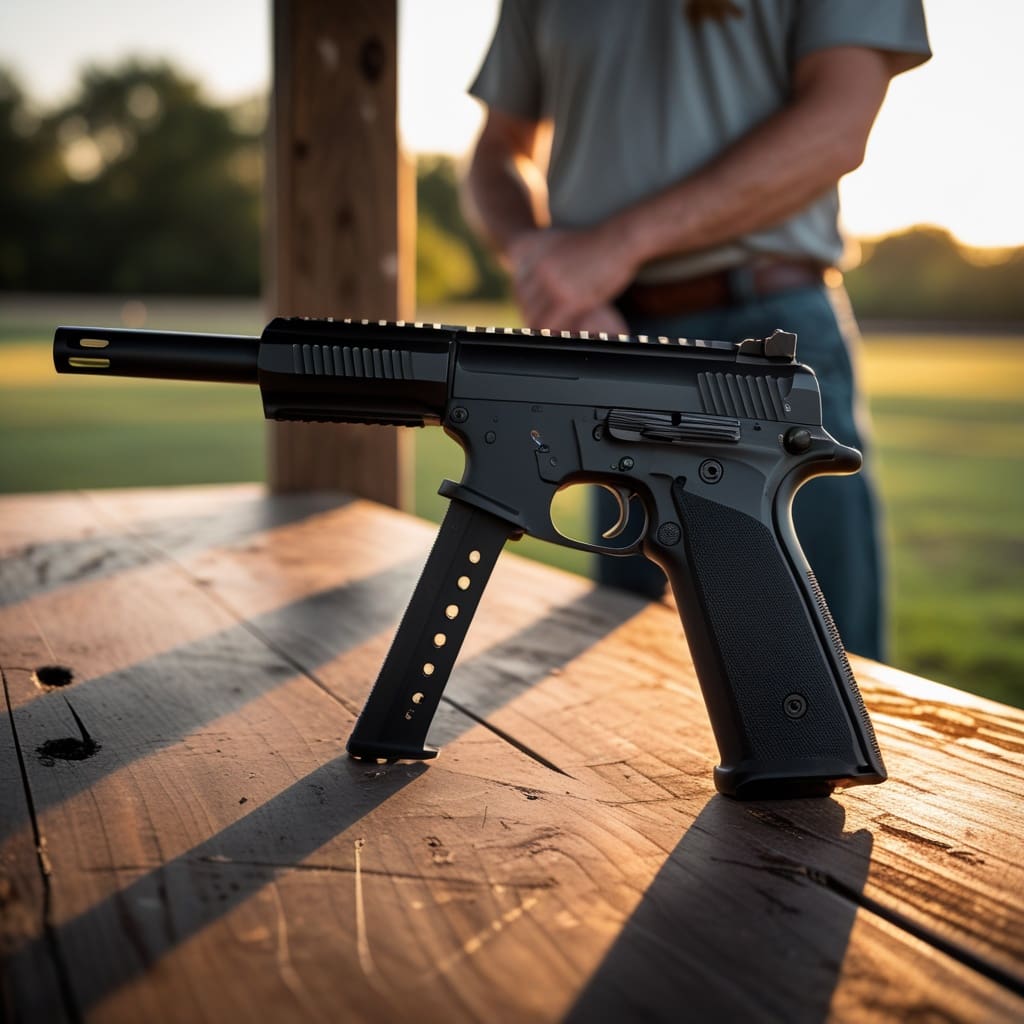
An AR pistol is a firearm built on an AR-15 style receiver, without a shoulder stock, with an overall length under 26 inches and no rifled barrel longer than 16 inches attached to a stock. It is federally classified as a handgun, not a rifle, which means it does not require the tax stamp, wait time, or paperwork associated with short-barreled rifles under the National Firearms Act. Millions of these firearms are in circulation across the United States, and demand has only grown since manufacturers began offering stabilizing braces and dedicated pistol-length components. This guide explains the legal framework, the brace question that has confused buyers for years, and how to pick a caliber and configuration that actually works.
Key Takeaways
- An AR pistol is legally a handgun under federal law, built without a shoulder stock and typically under 26 inches overall.
- Federal law does not require an NFA tax stamp for a standard AR pistol, but adding a vertical foregrip or shouldering certain braces improperly can change that classification.
- The ATF’s 2023 pistol brace rule (often called the “stabilizing brace rule” or Final Rule 2023R-08F) was vacated nationwide following federal court rulings, meaning braced AR pistols are not currently treated as NFA-regulated short-barreled rifles.
- Popular AR pistol calibers include 5.56 NATO.300 Blackout, and 9mm, each with different tradeoffs in barrel length, recoil, and ballistic performance.
- State laws vary significantly, and some states (California, New York, Illinois, and others) impose additional restrictions on braces, magazine capacity, or pistol grip configurations regardless of federal status.
- Prices for a complete AR pistol typically range from $700 for an entry-level build to over $2,000 for a premium configuration with a quality brace and optic.
What Exactly Is an AR Pistol?
An AR pistol is a firearm built on an AR-15 lower receiver that is manufactured or assembled from the start without a buttstock, giving it a legal classification as a pistol rather than a rifle. Because it lacks a stock, it falls outside the National Firearms Act definition of a short-barreled rifle, even though its barrel is often shorter than the 16-inch minimum required for a standard AR-15 rifle. Most AR pistols use barrels between 7.5 and 12.5 inches, paired with a pistol buffer tube and some form of arm brace or simple end plate for stability.
The distinction matters because the same firearm, built the same way but with a shoulder stock instead of a buffer tube, becomes a short-barreled rifle the moment the barrel drops below 16 inches. That reclassification triggers NFA requirements, including a $200 tax stamp, an ATF Form 1 or Form 4 application, and a waiting period that has historically run anywhere from 1 to 12 months depending on whether the application is filed as an individual or through a gun trust using the eForms system. Building or buying an AR pistol correctly from the outset avoids that entire process.
How Is an AR Pistol Different From an AR-15 Rifle?
An AR pistol and an AR-15 rifle share the same basic operating system, but they differ in three legally significant ways: overall length, barrel length, and the presence of a stock. A rifle-configured AR-15 must have a barrel of at least 16 inches and an overall length of at least 26 inches to avoid NFA classification, while an ar-15 pistol has no minimum barrel length requirement because it is not held to the same rifle standard.
Practically speaking, the AR pistol trades some ballistic performance and shootability for a smaller, more maneuverable package. A 7.5-inch barrel produces significantly more muzzle blast and a shorter effective range than a 16-inch rifle barrel, but it also weighs less, fits in a smaller bag, and is easier to store or transport. Many buyers choose an AR pistol specifically because it can be purchased and taken home the same day, with no waiting period beyond the standard NICS background check required for any handgun purchase, typically completed in under 30 minutes at a licensed dealer.
Is an AR Pistol Legal to Own?
Yes, an AR pistol is legal to own under federal law in most states, provided it meets the ATF’s definition of a pistol and complies with state-level restrictions. Federal law under 18 U.S.C. 921 and the regulations enforced by the Bureau of Alcohol, Tobacco, Firearms and Explosives treat a correctly configured AR pistol as a handgun, subject to the same purchase process as any other pistol: a Form 4473, a NICS background check, and compliance with the minimum purchase age of 21 for a licensed dealer sale.
What Are the Current AR Pistol Brace Laws?
The stabilizing brace has been the single most contentious issue in the AR pistol market since 2023, and the legal landscape has shifted more than once. In January 2023, the ATF published Final Rule 2023R-08F, which reclassified most pistol-braced firearms as short-barreled rifles subject to NFA registration, giving owners a choice to register, remove the brace, permanently alter the firearm, surrender it, or destroy it.

What Is the Best AR Pistol Caliber?
The best AR pistol caliber depends on how you’ll use it, but 5.56 NATO.300 Blackout, and 9mm cover most needs. Short barrels change how each round performs, so the right choice comes down to cost, recoil, and range.
5.56 NATO: The Versatile Default
5.56 NATO stays popular because ammo is cheap, around $0.35 to $0.55 a round. Short barrels cost you 700 to 900 fps of velocity and add more blast and flash, but it still handles home defense and range use fine.
.300 Blackout: Built for Short Barrels
.300 Blackout was built for barrels as short as 9 inches, so it keeps its performance better than 5.56 at pistol lengths. Subsonic loads with a suppressor run quiet with little recoil. Expect $0.60 to $1.00 a round, plus a dedicated barrel and bolt.
9mm: Compact and Low Recoil
9mm AR pistols, usually blowback PCCs, offer the lightest recoil, cheapest ammo ($0.20 to $0.30 a round), and use common pistol mags like Glock’s. Range and stopping power drop off, so it fits close-range home defense better than field use.
Barrel length and caliber work together, since a round built for 16 inches won’t act the same out of 7.5. Compare barrel lengths and calibers before you build your upper.
AR Pistol Caliber Comparison
- 5.56 NATO: Barrel range 7.5 to 10.5 inches. Typical cost per round $0.35 to $0.55. Best for general use, home defense, and range shooting where ammo cost matters.
- .300 Blackout: Barrel range 7.5 to 9 inches. Typical cost per round $0.60 to $1.00. Best for suppressed use and short-barrel ballistic performance.
- 9mm: Barrel range 5 to 8 inches. Typical cost per round $0.20 to $0.30. Best for low recoil, low cost, and magazine compatibility with a duty or carry pistol.
- 7.62x39mm: Barrel range 8 to 10.5 inches. Typical cost per round $0.40 to $0.60. Best for buyers wanting AK-pattern ballistics in an AR platform.
How Much Does an AR Pistol Cost?
A complete, ready-to-shoot AR pistol usually runs $700 to $2,200, depending on the brand, caliber, and accessories included. Budget models start around $650 to $900 with a basic barrel, standard bolt carrier group, and an economical brace. Mid-range builds ($1,000 to $1,500) from established manufacturers add a nitride or chrome-lined barrel, a better trigger, and a name-brand brace.
Premium AR pistols from precision builders can cost $1,600 to $2,500 or more, with match-grade barrels, gas systems tuned for shorter barrels, and optics-ready receivers. Building your own from separate parts can land anywhere in this range, and many people go this route to control cost and pick the caliber and barrel length they actually want. If you’d rather buy a finished, compliant firearm instead of assembling one, you can browse legally compliant AR pistol builds to compare current options by caliber and price.
Typical Cost Breakdown for a Mid-Range Build
- Stripped lower receiver: $80 to $150.
- Lower parts kit and pistol buffer tube assembly: $90 to $160.
- Complete upper with barrel (7.5 to 10.5 inches): $400 to $700.
- Stabilizing brace: $100 to $250.
- Red dot optic: $150 to $400.
- Total estimated cost: $820 to $1,660 before tax and transfer fees.
FFL transfer fees for the finished firearm typically add another $25 to $75.
How Do You Buy an AR Pistol Legally?
Buying an AR pistol legally follows the same basic path as buying any other handgun from a licensed dealer, with a few extra considerations specific to the platform. Here is the process step by step:
- Confirm state eligibility. Check your state’s assault weapon and magazine capacity laws before shopping, since a handful of states restrict AR pistol configurations regardless of federal status.
- Select a caliber and barrel length. Match the cartridge to your intended use, whether that is home defense, range plinking, or suppressed shooting.
- Purchase through a licensed FFL dealer. Complete ATF Form 4473 and pass the NICS background check, which the FBI reports clears more than 90 percent of applicants within the standard three-business-day window, often within minutes at the point of sale.
- Verify the transfer age requirement. Federal law requires buyers to be at least 21 years old to purchase a handgun, including an AR pistol, from a licensed dealer.
- Register locally if required. A small number of jurisdictions, including parts of California and New York, require additional state or local registration after purchase.
Private-party sales are legal in many states without a dealer transfer, but interstate private sales still generally require going through an FFL. Confirm your specific state’s private sale rules before assuming a face-to-face transaction is permitted.
What Should You Consider Before Buying an AR Pistol?
Beyond caliber and legal compliance, a few practical factors separate a satisfying AR pistol purchase from a disappointing one. Recoil impulse from a short-barreled, unbuffered AR pistol can feel noticeably sharper than a rifle in the same caliber, since the shorter barrel and lighter overall weight reduce the system’s ability to absorb recoil energy. A properly tuned gas system, sized specifically for pistol-length barrels rather than a generic carbine-length setting, makes a measurable difference in reliability and felt recoil.
Intended use should drive the final configuration. A home-defense AR pistol benefits from a weapon-mounted light, a compact red dot optic, and a caliber like 5.56 or 9mm that balances capability with manageable recoil in close quarters. A range or suppressor-focused build often favors .300 Blackout with a longer 9-inch barrel to maximize the cartridge’s designed performance envelope. Weight also matters more than most first-time buyers expect: a fully accessorized AR pistol with an optic, light, and brace can approach 6 to 7 pounds, which affects one-handed handling more than many buyers anticipate before holding one in person.
Call to Action
Choosing the right AR pistol comes down to matching caliber, barrel length, and brace configuration to how you actually plan to use the firearm, not just what looks impressive on paper. If you are ready to compare finished, compliant builds against your state’s specific requirements, take a closer look at current inventory and configurations built to match today’s regulatory landscape before making a final decision.
Conclusion
An AR pistol offers a legal, compact alternative to a short-barreled rifle without the NFA tax stamp and waiting period, provided it is built and purchased correctly under current federal definitions. The regulatory picture around stabilizing braces has shifted substantially since 2023, and staying current on the latest court rulings and ATF guidance matters more with this platform than with almost any other firearm category. Caliber choice, whether 5.56 NATO.300 Blackout, or 9mm, should be driven by intended use rather than trend, since each cartridge behaves differently once barrel length drops into pistol territory. With federal law, state statutes, and brace regulations all factored in, a well-chosen AR pistol remains one of the most flexible firearms a buyer can own in 2026.
Frequently Asked Questions
Do I need a tax stamp for an AR pistol?
No, a standard AR pistol does not require an NFA tax stamp under current federal law. The tax stamp requirement applies to short-barreled rifles and other NFA items, and a correctly configured AR pistol without a shoulder stock falls outside that classification. This could change again if the ATF issues new brace regulations, so it is worth checking current guidance before purchase.
Can I shoulder a brace on my AR pistol?
Under current federal guidance, shouldering a stabilizing brace does not by itself reclassify the firearm. Earlier ATF guidance suggested shouldering could trigger reclassification, but that position has shifted multiple times through litigation. Because this remains one of the more actively contested areas of firearms law, confirm the current ATF stance before relying on it as settled practice.
What is the minimum barrel length for an AR pistol?
There is no federal minimum barrel length for an AR pistol, unlike the 16-inch minimum required for a rifle. Most manufacturers use barrels between 7.5 and 12.5 inches to balance ballistic performance with the compact size that makes the platform appealing in the first place.
Is a 9mm or 5.56 AR pistol better for home defense?
Both work well for home defense, but 9mm typically offers lower recoil and easier handling in close quarters, while 5.56 offers more stopping power at slightly greater range. A 9mm build also lets you share magazines with a compatible handgun, which some owners find practical for household ammunition and magazine standardization.
Can I add a vertical foregrip to my AR pistol?
Adding a true vertical foregrip to an AR pistol can reclassify it as an “Any Other Weapon” under the NFA, requiring a $5 tax stamp and registration. Angled foregrips are generally treated differently from vertical grips under current ATF interpretation, but the distinction is technical and worth confirming with a firearms attorney or the ATF directly before installing one.


